KNOKOO FES220 Laser Treatment Smoke Extraction Solution
Laser Treatment Smoke Extraction for Scar Treatment Clinics
KNOKOO FES220 in a Polish clinic: bedside source capture, three-stage filtration and practical day-to-day operation.
Laser scar treatment can generate smoke when tissue is heated or ablated. For clinics carrying out smoke-generating procedures, an extraction solution needs to address airborne particles and odors while fitting around the treatment bed and the practitioner's workflow.
KNOKOO combines adjustable source capture with staged filtration to help clinics manage laser treatment smoke where it is generated. This application example shows how a customer in Poland positioned the FES220 alongside a treatment bed and incorporated extraction into the treatment setup.
A clinic in Poland uses the KNOKOO FES220 during laser scar treatment. Customer-supplied photographs show the white extraction unit beside the treatment bed, with a flexible arm extending a transparent capture hood toward the working area.
This freestanding arrangement allows the hood to be repositioned as the treatment area changes, without relying on a fixed overhead extraction point. The unit's placement and hose routing can be planned around access to the patient, the laser equipment and the practitioner's working position.
Effective smoke control starts at the capture hood. The FES220's adjustable extraction arm allows the inlet to be directed toward the smoke source. Its transparent hood helps the practitioner see the treatment area while setting the capture position.
The inlet should be positioned as close as practicable without touching the patient or interfering with treatment. NIOSH guidance recommends keeping the extraction inlet within approximately 5 cm (2 inches) of the smoke-generating site.[1] This is general guidance: hood geometry, airflow and the actual treatment setup still need to be assessed.
Extraction should operate whenever smoke is generated. As the practitioner moves to another treatment area, the hood should be adjusted to maintain capture and avoid drawing smoke across the practitioner's breathing zone. General room ventilation remains part of the overall control arrangement.
Three-Stage Filtration: Separate Functions for Particles and Odors
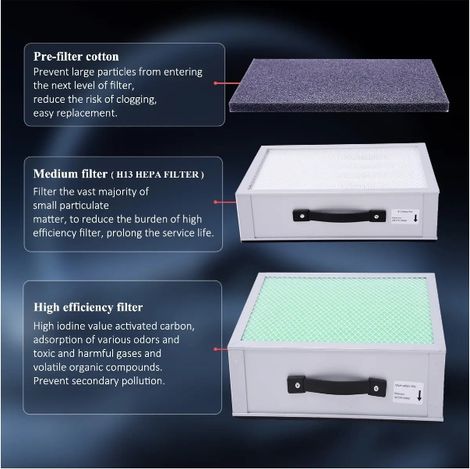
The supplied FES220 product information specifies a pre-filter, an H13 HEPA filter and an activated carbon filter. Each stage serves a different purpose.
| Stage | Function | Operational benefit |
|---|
| Pre-filter | Intercepts larger particles and debris | Reduces loading on downstream filters and supports routine maintenance |
| H13 HEPA filter | Captures fine particles carried into the filtration system | Provides the fine-particle filtration stage |
| Activated carbon filter | Adsorbs suitable gas-phase compounds | Supports odor management and treatment of selected gaseous contaminants |
Particle filtration and gas adsorption must be considered separately. HEPA filters capture particles; activated carbon addresses compounds that can be adsorbed by the selected media. Adsorption performance depends on the compound, concentration, humidity, contact time and remaining media capacity. Reduced odor alone does not establish that all airborne contaminants have been adequately controlled.
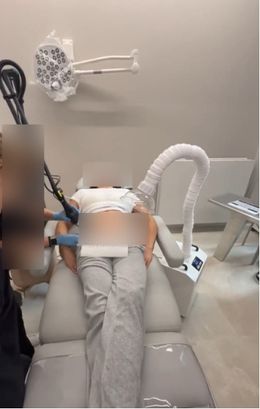
Figure 1. FES220 positioned beside the treatment bed at the Polish clinic, with the extraction arm directed toward the treatment area.
Customer Feedback from the Treatment Room
After putting the unit into use, the customer shared a treatment-room photograph and sent KNOKOO the following messages:
"Thank You"
"It works amazing !!!"
This direct feedback reflects the customer's positive experience with the equipment in use. Together with the installation photographs, it provides a practical example of FES220 deployment during laser scar treatment. No quantitative air-quality measurements were supplied for this case.
Figure 2. FES220 filter configuration: pre-filter, H13 HEPA filter and activated carbon filter. The original graphic uses different stage names; the functions are explained below.
Discuss Your Clinic's Extraction Requirements with KNOKOO
KNOKOO can help match the extraction unit, capture hood and filter configuration to your working conditions. Share your laser type, smoke-generating procedure, daily treatment workload, available bedside space and ventilation arrangement with our team.
Contact KNOKOO to discuss a laser treatment smoke extraction solution for your clinic.
Technical note:
Specifications are based on the supplied product information. The stated airflow is not a measured capture rate at the hood. The supplied materials list both H13 and "99.97% at 0.3 µm"; without the corresponding test reports, these are not treated as equivalent or as evidence of whole-system removal efficiency. This application case does not establish medical-device registration or clinical efficacy.
Reference [1]: CDC / NIOSH - Control of Smoke From Laser/Electric Surgical Procedures. General control guidance, not an evaluation or certification of the FES220.